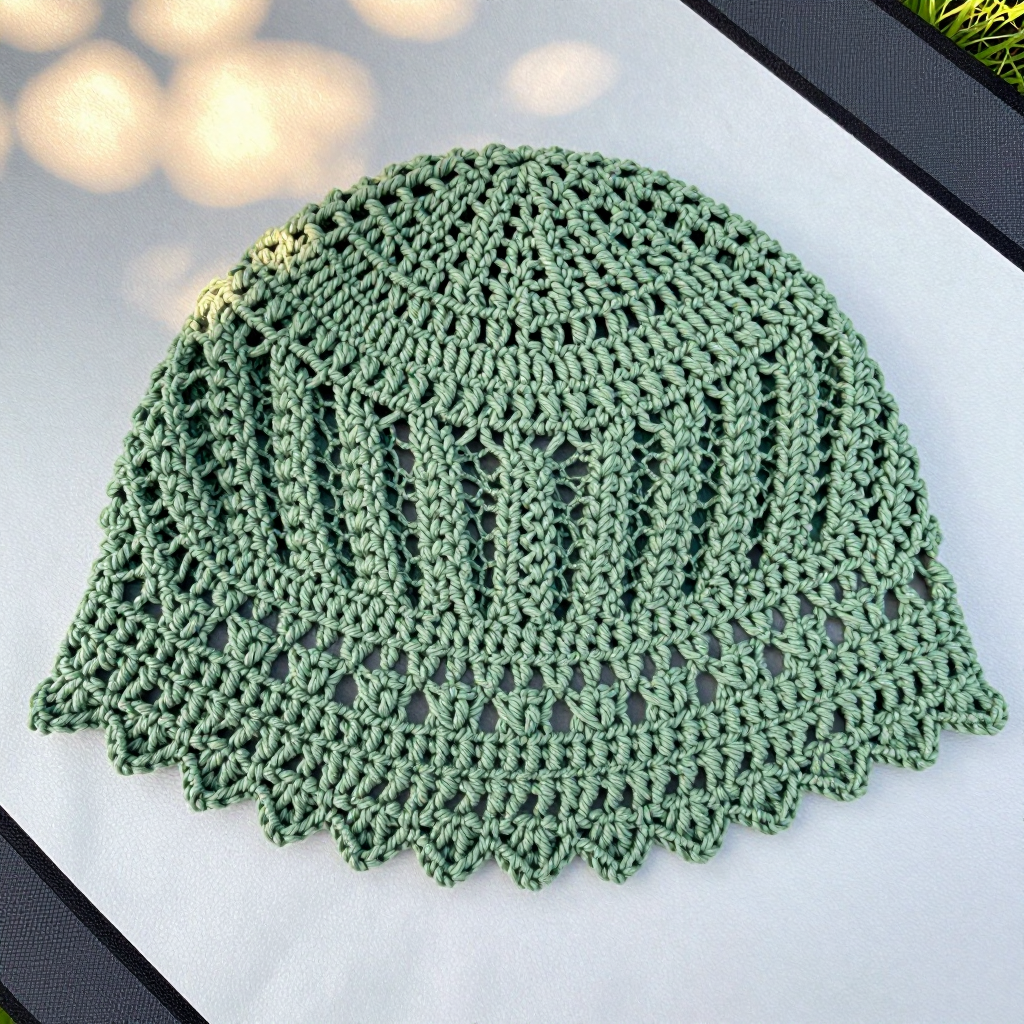
Saffron Grid Bobble Bucket Hat Free Crochet Pattern

Saffron Grid Bobble Bucket Hat Free Crochet Pattern
Introduction
If you have ever wanted to make a hat that looks like it came straight out of a Y2K music video, this is the project for you. The Saffron Grid Bobble Bucket Hat is worked top-down in continuous rounds, starting with a smooth flat crown and finishing with a straight cylinder brim covered in a two-color bobble checkerboard. Saffron and rust squares pop against a smooth single crochet background, giving the hat a bold, pixel-like look that is surprisingly easy to create. This pattern is perfect for a confident first-time crocheter who has learned single crochet and wants to try a special stitch and simple color changes. The finished hat is soft, matte, and squishy, with raised bobbles that you can actually feel, and it measures about 21 inches around and 7.5 inches tall, a perfect teen or small adult fit.
Materials Needed
- Yarn: Worsted weight (#4) acrylic yarn, approximately 180–200 yards total: 110 yards saffron (Color A) and 70 yards rust (Color B).
- Hook: 5.0 mm (US H-8) crochet hook.
- Stitch markers: At least 2, to mark the first stitch of each round and to hold your place in the color sequence.
- Tapestry needle: A blunt-tipped yarn needle for weaving in ends.
- Scissors: Sharp craft scissors for cutting yarn.
- Finished size: Teen / Small Adult — approximately 21 inches circumference at the brim, 7.5 inches tall total (4-inch crown plus 3.5-inch brim).
Abbreviations and Beginner Glossary
- ch — chain: yarn over the hook and pull it through the loop on your hook to make one chain.
- sc — single crochet: insert your hook into the stitch, yarn over, pull up a loop (2 loops on hook), yarn over again, and pull through both loops.
- sc2tog — single crochet 2 together: a decrease. Insert hook into the next stitch, yarn over, pull up a loop, insert hook into the following stitch, yarn over, pull up a loop, then yarn over and pull through all 3 loops. (Listed for reference; this pattern does not use it.)
- sl st — slip stitch: insert your hook into the stitch, yarn over, and pull the yarn through both the stitch and the loop on your hook in one motion.
- bobble — 4-dc bobble: see the Special Stitch below. It makes a raised bump on the outside of the fabric.
- dc — double crochet: yarn over, insert hook into stitch, yarn over, pull up a loop (3 loops on hook), yarn over and pull through 2 loops, yarn over and pull through the last 2 loops.
- st(s) — stitch(es): one completed loop of yarn in your fabric.
- A — saffron (Color A).
- B — rust (Color B).
- Magic ring — an adjustable loop you pull closed to start a circle with no hole in the middle.
- Continuous rounds — working in a spiral without joining at the end of each round, so you never stop to slip stitch.
- Back loop only — working into just the back half of the V-shaped stitch top, which leaves a crisp ridge.
- Yarn over — wrapping the working yarn over your hook from back to front.
Special Stitch — 4-dc Bobble
Yarn over, insert hook in the indicated stitch, yarn over and pull up a loop, yarn over and draw through 2 loops (2 loops remain on hook). Repeat this 3 more times in the same stitch (5 loops on hook). Yarn over and draw through all 5 loops. Push the bobble to the right side (outside) of the fabric. Change color as needed on the final yarn-over of the bobble or the following sc.
Gauge
Gauge: 4 single crochet stitches = 1 inch; 4.5 rounds = 1 inch in single crochet after blocking.
Gauge matters because it decides whether your hat fits. If your stitches are bigger than the gauge, the hat will be too loose; if they are smaller, it will be too tight. To make a gauge swatch, chain 20, then single crochet in each chain across and work about 15 rows of single crochet. Lay the swatch flat, measure 4 inches across the middle, and count the stitches. If you have more than 16 stitches in 4 inches, try a larger hook; if you have fewer, try a smaller hook. Always measure after gently blocking, because acrylic yarn relaxes slightly.
Beginner Tips Before You Start
- Use a stitch marker. Place it in the first stitch of every round. In continuous rounds there is no seam to guide you, so the marker is your only way to know where a round begins.
- Do not pull your yarn too tight. Tension is the number one beginner issue. Keep your loops relaxed so the bobbles sit up nicely and the hat stays soft.
- Count your bobbles. Every bobble round should have exactly 14 bobbles. If you have 13 or 15, you have drifted; count again before moving on.
- Carry colors loosely. When you switch from saffron to rust, leave the unused yarn relaxed along the inside. Catching it every 3–4 stitches prevents long floats that snag.
- Practice one bobble first. Make a single bobble on a scrap swatch before starting the hat so your hands learn the motion.
- Keep the crown flat. If the crown starts to cup upward, your stitches are too tight; if it ripples, they are too loose.
Step-by-Step Instructions
Crown (worked in continuous rounds with A, do not join, use a stitch marker)
Round 1: Make a magic ring, ch 1, work 6 sc into ring. Pull ring closed. (6 sc)
Round 2: 2 sc in each st around. (12 sc)
Round 3: [2 sc in next st, sc in next st] around. (18 sc)
Round 4: [2 sc in next st, sc in next 2 sts] around. (24 sc)
Round 5: [2 sc in next st, sc in next 3 sts] around. (30 sc)
Round 6: [2 sc in next st, sc in next 4 sts] around. (36 sc)
Round 7: [2 sc in next st, sc in next 5 sts] around. (42 sc)
Round 8: [2 sc in next st, sc in next 6 sts] around. (48 sc)
Round 9: [2 sc in next st, sc in next 7 sts] around. (54 sc)
Round 10: [2 sc in next st, sc in next 8 sts] around. (60 sc)
Round 11: [2 sc in next st, sc in next 9 sts] around. (66 sc)
Round 12: [2 sc in next st, sc in next 10 sts] around. (72 sc)
Round 13: [2 sc in next st, sc in next 11 sts] around. (78 sc)
Round 14: [2 sc in next st, sc in next 12 sts] around. (84 sc)
The crown should measure approximately 4 inches in diameter at the center and 6.5 inches across the flat circle. Do not fasten off.
Sides — Bobble Checkerboard (worked straight, no increases, in continuous rounds)
The sides are worked over 84 stitches in a 6-stitch repeat: each checkerboard square is 6 stitches wide and 3 rounds tall. Bobbles alternate in 6-stitch blocks every 3 rounds, creating a staggered checkerboard.
Round 15 (A): Sc in each st around. (84 sc)
Round 16 (A): *Sc in next 3 sts, bobble in next st, sc in next 2 sts; repeat from * around. (14 bobbles)
Round 17 (A): Sc in each st around. (84 sc)
Round 18 (B): *Bobble in next st, sc in next 5 sts; repeat from * around. (14 bobbles)
Round 19 (B): Sc in each st around. (84 sc)
Round 20 (B): *Sc in next 3 sts, bobble in next st, sc in next 2 sts; repeat from * around. (14 bobbles)
Round 21 (A): Sc in each st around. (84 sc)
Round 22 (A): *Bobble in next st, sc in next 5 sts; repeat from * around. (14 bobbles)
Round 23 (A): Sc in each st around. (84 sc)
Round 24 (B): *Sc in next 3 sts, bobble in next st, sc in next 2 sts; repeat from * around. (14 bobbles)
Round 25 (B): Sc in each st around. (84 sc)
Round 26 (B): *Bobble in next st, sc in next 5 sts; repeat from * around. (14 bobbles)
Round 27 (A): Sc in each st around. (84 sc)
Round 28 (A): *Sc in next 3 sts, bobble in next st, sc in next 2 sts; repeat from * around. (14 bobbles)
Round 29 (A): Sc in each st around. (84 sc)
Round 30 (B): *Bobble in next st, sc in next 5 sts; repeat from * around. (14 bobbles)
Round 31 (B): Sc in each st around. (84 sc)
Round 32 (B): *Sc in next 3 sts, bobble in next st, sc in next 2 sts; repeat from * around. (14 bobbles)
Round 33 (A): Sc in each st around. (84 sc)
Round 34 (A): *Bobble in next st, sc in next 5 sts; repeat from * around. (14 bobbles)
Round 35 (A): Sc in each st around. (84 sc)
Round 36 (B): *Sc in next 3 sts, bobble in next st, sc in next 2 sts; repeat from * around. (14 bobbles)
Round 37 (B): Sc in each st around. (84 sc)
Round 38 (B): *Bobble in next st, sc in next 5 sts; repeat from * around. (14 bobbles)
Round 39 (A): Sc in each st around. (84 sc)
Round 40 (A): *Sc in next 3 sts, bobble in next st, sc in next 2 sts; repeat from * around. (14 bobbles)
Round 41 (A): Sc in each st around. (84 sc)
Round 42 (B): *Bobble in next st, sc in next 5 sts; repeat from * around. (14 bobbles)
Round 43 (B): Sc in each st around. (84 sc)
Round 44 (B): *Sc in next 3 sts, bobble in next st, sc in next 2 sts; repeat from * around. (14 bobbles)
Round 45 (A): Sc in each st around. (84 sc)
Round 46 (A): *Bobble in next st, sc in next 5 sts; repeat from * around. (14 bobbles)
Round 47 (A): Sc in each st around. (84 sc)
Round 48 (B): *Sc in next 3 sts, bobble in next st, sc in next 2 sts; repeat from * around. (14 bobbles)
Round 49 (B): Sc in each st around. (84 sc)
Round 50 (B): *Bobble in next st, sc in next 5 sts; repeat from * around. (14 bobbles)
Round 51 (A): Sc in each st around. (84 sc)
Round 52 (A): *Sc in next 3 sts, bobble in next st, sc in next 2 sts; repeat from * around. (14 bobbles)
Round 53 (A): Sc in each st around. (84 sc)
Round 54 (B): *Bobble in next st, sc in next 5 sts; repeat from * around. (14 bobbles)
Round 55 (B): Sc in each st around. (84 sc)
Round 56 (B): *Sc in next 3 sts, bobble in next st, sc in next 2 sts; repeat from * around. (14 bobbles)
Round 57 (A): Sc in each st around. (84 sc)
Round 58 (A): *Bobble in next st, sc in next 5 sts; repeat from * around. (14 bobbles)
Round 59 (A): Sc in each st around. (84 sc)
Round 60 (B): *Sc in next 3 sts, bobble in next st, sc in next 2 sts; repeat from * around. (14 bobbles)
Round 61 (B): Sc in each st around. (84 sc)
Round 62 (B): *Bobble in next st, sc in next 5 sts; repeat from * around. (14 bobbles)
Round 63 (A): Sc in each st around. Do not fasten off. (84 sc)
Brim (worked in A, continuous rounds)
Round 64: Sc in each st around. (84 sc)
Round 65: [2 sc in next st, sc in next 20 sts] around. (88 sc)
Round 66: Sc in each st around. (88 sc)
Round 67: [2 sc in next st, sc in next 21 sts] around. (92 sc)
Round 68: Sc in each st around. (92 sc)
Round 69: [2 sc in next st, sc in next 22 sts] around. (96 sc)
Rounds 70–74: Sc in each st around. (96 sc)
Round 75: Sc in each st around, working through the back loop only for a crisp brim edge. (96 sc)
Round 76: Sc in each st around. Sl st in next st. Fasten off, weave in ends. (96 sc)
Assembly and Finishing
This hat is made in one piece, so there are no seams to sew. Start by weaving in all ends with your tapestry needle: thread each tail onto the needle and run it back and forth through the inside of the fabric for about 2 inches, then trim close to the fabric. Next, gently steam-block the hat. Hold a steam iron an inch or two above the crown (never press it down onto the acrylic, which can melt), let the steam relax the fabric, and pat the crown flat with your hand. Shape the brim into a soft downward curve with your fingers and let the hat dry completely. Do not press the bobbles flat — they are the star of the design. Your hat should measure approximately 21 inches circumference at the brim, 7.5 inches tall, with a 4-inch crown and 3.5-inch brim.
Pro Tips and Variations
- Change the colors: Swap saffron and rust for any two colors you love, such as cream and sage or black and hot pink. Keep one color light and one dark so the checkerboard pops.
- Adjust the size: For a smaller child size, stop the crown increases at Round 12 (72 sts) and work the sides over 72 stitches, which divides evenly into the 6-stitch repeat. For a larger adult size, add Round 15 of increases to reach 90 sts before starting the sides.
- Substitute yarn: Cotton or cotton-blend worsted weight works beautifully and gives a crisper brim. Always check your gauge again, because cotton behaves differently from acrylic.
- Make a plain version: Skip the bobbles and work every side round as plain single crochet for a simple two-color striped bucket hat that is even faster to finish.