Prairie Scale Riding Shorts: Free Crochet Pattern with Crocodile Stitch Cuffs

Prairie Scale Riding Shorts: Free Crochet Pattern with Crocodile Stitch Cuffs
Introduction
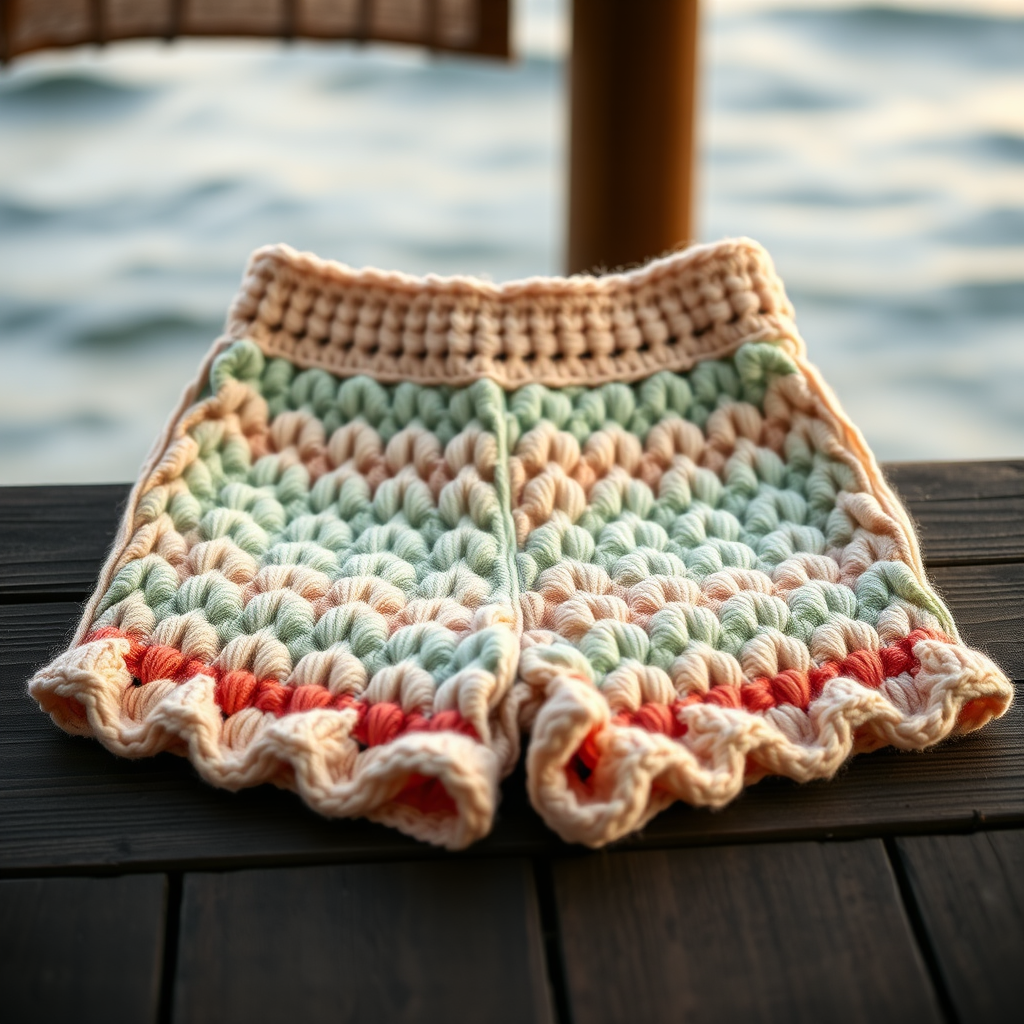
If you have ever wanted to crochet something that looks far more complicated than it actually is, these Prairie Scale Riding Shorts are exactly the project for you. They are perfect for a complete beginner who has just learned single crochet and is ready for one small, exciting challenge: the crocodile stitch. The body of the shorts is just a simple tube of single crochet worked in the round from the waist down to the thigh, so you get lots of relaxing practice before you reach the fun part. The finished shorts are snug and fitted like real riding shorts, with a short five-inch inseam and a single band of raised, pointed cobalt scales around each cuff, each one outlined in a bright orange edging. They feel dense, warm, and slightly stretchy, like a cozy second skin, and the scale band gives them a bold western look that makes people ask, "You made those?"
Materials Needed
- Yarn: Fingering weight (size 1) wool yarn, approximately 875–1,050 yards total: 800–950 yards cobalt (main color) and 75–100 yards orange (edging).
- Crochet hook: Size D/3 (3.25 mm), or whatever size you need to match the gauge below.
- Stitch marker: At least one, to mark the first stitch of each round.
- Tapestry needle: A blunt, large-eyed needle for weaving in ends.
- Scissors: Any small, sharp pair.
- Optional: 1 yard (1 meter) of elastic, 3/4 inch (2 cm) wide, for a secure waistband.
- Finished sizes: Teen XS (S, M, L) — finished hip circumference 30 (32, 34, 36) inches / 76 (81, 86, 91) cm; finished inseam 5 inches / 13 cm; rise 9 (9 1/2, 10, 10 1/2) inches / 23 (24, 25, 27) cm. The shorts are designed with about 1 inch / 2.5 cm of negative ease at the hip, which means they are intentionally a little smaller than the body so they sit snug. The sample shown is size S.
Abbreviations and Beginner Glossary
- ch — chain: wrap the yarn over your hook and pull it through the loop already on your hook. This makes a small link.
- sc — single crochet: insert your hook into the stitch, pull up a loop (two loops on hook), yarn over, pull through both loops. One loop remains.
- dc — double crochet: yarn over, insert hook into the stitch, pull up a loop (three loops on hook), yarn over, pull through two loops, yarn over, pull through the last two loops.
- sl st — slip stitch: insert your hook into the stitch, yarn over, and pull that loop straight through the loop on your hook. It joins without adding height.
- sc2tog — single crochet 2 together (a decrease): insert hook into the first stitch, pull up a loop, insert hook into the next stitch, pull up a loop, yarn over, pull through all three loops. Two stitches become one.
- FLO — front loop only: work into just the loop of the stitch closest to you.
- BLO — back loop only: work into just the loop of the stitch farthest from you.
- rnd — round: one complete circle of stitches worked in the round.
- st(s) — stitch(es).
- RS / WS — right side (the outside of the shorts) / wrong side (the inside).
- post of a stitch — the vertical body of the stitch below the top loops. In the crocodile stitch you work down and up this post.
- scale — one pointed crocodile-stitch unit, made by working 5 dc down one post and 5 dc up the next post.
Gauge
22 sc x 24 rounds = 4 inches (10 cm) in single crochet worked in the round. One completed crocodile scale measures approximately 1 1/4 inches (3 cm) wide by 1 1/2 inches (4 cm) tall.
Gauge matters because it controls the size of your shorts. If your stitches are bigger than this, the shorts will come out too loose; if they are smaller, they may not fit over the hips. To check, crochet a small flat swatch of about 30 single crochet stitches and 30 rows, then lay a ruler across the middle and count how many stitches fit in 4 inches. If you have more stitches than 22, try a larger hook; if you have fewer, try a smaller hook. Wash and gently block your swatch before measuring, because wool relaxes slightly when wet.
Beginner Tips Before You Start
- Use a stitch marker every single round. Because the body is worked in a continuous spiral, there is no seam to tell you where a round begins. Clip your marker into the first stitch of each round and move it up as you go.
- Do not pull your yarn too tight. Tension is the number one reason beginners' shorts come out too small. Let the yarn flow smoothly and keep your loops relaxed.
- Try on as you go. Once the hip section is a few inches long, slip the tube over your hips (or over a pillow of the same size) to check the fit before you commit to the leg split.
- Practice one scale first. Before working the cuff, crochet a single scale on a scrap swatch. The motion of working down and up a post feels strange at first, then suddenly clicks.
- Count your stitches at the end of every round. The numbers in parentheses after each round tell you exactly how many stitches you should have.
- Keep your scale band loose. The crocodile stitch pulls in tightly. Work those double crochets with a relaxed hand so the cuff stays comfortable around the thigh.
Step-by-Step Instructions
Waistband (worked first, in cobalt)
With cobalt, ch 166 (176, 186, 196). Being careful not to twist the chain, join with a sl st to the first ch to form a ring.
Rnd 1: Ch 1, sc in each ch around. (166 [176, 186, 196] sc) Place a marker in the first st.
Rnds 2–4: Sc in each st around. (166 [176, 186, 196] sts) The waistband now measures about 1 inch / 2.5 cm.
Optional: After Rnd 4, thread the 3/4 inch elastic through the inside of the waistband, overlap the ends by 1 inch, and stitch them closed. This keeps the shorts secure during riding.
Hip Section (cobalt, worked in a continuous spiral)
Rnd 5: Sc in each st around. (166 [176, 186, 196] sts)
Repeat Rnd 5 until the piece measures 4 inches / 10 cm from the starting chain, which is approximately 24 rounds total from Rnd 1. (166 [176, 186, 196] sts)
Shaping the Seat (short rows, cobalt)
The back of the shorts is worked a little longer than the front for a comfortable riding fit. You will work back and forth in rows over part of the round, then rejoin.
Row 1 (RS): Sc in the next 83 (88, 93, 98) sts, turn. (83 [88, 93, 98] sts)
Row 2 (WS): Ch 1, sc in each st across, turn. (83 [88, 93, 98] sts)
Rows 3–6: Repeat Row 2. (83 [88, 93, 98] sts) Fasten off, leaving a 12 inch tail. Join yarn at the side seam and continue working in the round over all stitches, working 1 sc in each short-row edge stitch to close any gaps. (166 [176, 186, 196] sts)
Leg Openings (divide for legs)
Next rnd: Sc in the first 83 (88, 93, 98) sts (front), ch 4 (4, 5, 5), skip the next 83 (88, 93, 98) sts (back), join with a sl st to the first st. This small chain forms the crotch gusset.
Next rnd: Sc in each st and in each ch of the gusset around. (87 [92, 98, 103] sts for the first leg)
Work even in sc (continuous spiral, marker at the first st) until the leg measures 3 1/2 inches / 9 cm from the gusset. (87 [92, 98, 103] sts)
Cuff — Crocodile Scale Band (cobalt and orange)
The scale band is worked directly onto the live stitches of the cuff. The stitch count must be a multiple of 6 plus 1. If needed, work one decrease round (sc2tog evenly spaced) to reach the nearest multiple of 6 + 1: 85 (91, 97, 103) sts.
Set-up rnd (cobalt): Sc in each st around. (85 [91, 97, 103] sts)
Scale rnd (cobalt): Ch 1, turn. Skip the first sc, *work 5 dc down the post of the next sc (from top to bottom), ch 1, work 5 dc up the post of the same sc (from bottom to top), skip the next sc; repeat from * across, ending with 1 sc in the last st. (14 [15, 16, 17] scales)
Edging rnd (orange): Ch 1, turn. Work 1 sc in each dc and in each ch-1 space across, then 1 sc in each skipped sc, returning to the original stitch count. (85 [91, 97, 103] sc) Fasten off orange.
Second Leg
Join cobalt at the crotch gusset on the opposite side. Work 1 sc in each of the 83 (88, 93, 98) reserved back sts and in each ch of the gusset. (87 [92, 98, 103] sts)
Work even in sc until the leg measures 3 1/2 inches / 9 cm from the gusset. (87 [92, 98, 103] sts) Then work the cuff exactly as for the first leg: adjust the set-up round to a multiple of 6 + 1 (85 / 91 / 97 / 103 sts) and work 14 (15, 16, 17) scales, finishing with the orange edging round.
Assembly and Finishing
These shorts are crocheted in one piece, so there are no seams to sew. Finishing is simply tidying and shaping.
- Weave in ends: Thread each yarn tail onto the tapestry needle and run it back and forth through the inside of the fabric for about 2 inches, changing direction once so it cannot work loose. Trim close to the fabric.
- Close the gusset: If any small gap remains where the legs divide, use the 12 inch tail from the seat shaping and a few whip stitches (small stitches over the edge, side by side) to close it invisibly from the wrong side.
- Block: Soak the shorts in cool water for 15 minutes, squeeze gently in a towel (never wring), and lay them flat to the measurements above. Pin the scale bands flat so the chevron points sit evenly and the orange edging shows clearly.
- Steam carefully: Do not press the scales flat with an iron. Steam gently from the wrong side only, holding the iron just above the fabric.
Pro Tips and Variations
- Change the colors: Swap the cobalt and orange for any two contrasting shades. A deep plum with mustard, or forest green with cream, gives a completely different look while keeping the same scale drama.
- Adjust the size: To make the shorts larger or smaller, add or remove 6 stitches from the starting chain (one full scale repeat). Every other number in the pattern shifts by the same amount, so the scale band always works out evenly.
- Substitute the yarn: A fingering weight wool-nylon blend adds durability and a little more stretch. Avoid pure cotton, which has no bounce and will sag at the seat.
- Add more scales: For a taller, bolder cuff, work a second scale round directly on top of the first before the orange edging. Each extra round adds about 1 1/2 inches / 4 cm of scale height.